Tuesday, November 18, 2008

Nice chicken curry

This chicken curry turned out so nice I took pictures of it, and even took the time to write this blog post...

From Chicken Curry


The ingredients were somewhat made up on the spot. I started with Pataks Mild Curry paste, which is tasty, but unfortunately it is mostly oil and salt. Still, I was hungry, and it has a good bunch of spices and herbs in it too.

Then I added some left over tomato sauce from Saturday, which was home made and salt free. This was cherry tomatoes (canned, but no added salt), onions, garlic and some Italian herbs.

The curry paste went into a pint jug with the tomato sauce, 1/2 a pint of chicken stock, some red wine, salt and pepper.

I fried up chicken breasts, and at the same time put some diced potatoes on to boil, and started up the rice.

After about 8 mins, the chicken was cooked and I threw some broccoli florets in with the potatoes.

Then I drained the broccoli and the potatoes and threw them in with the chicken, and poured the pint jug of good stuff over it all and stirred it all up.

Simmered for about 10 minutes, and then ate.

It would have been nice with some nan bread, but you can't have everything.

Tuesday, November 11, 2008

Science world

Corbey, Jamie and I went to Science World on Sunday to check out the new Fossils, Fins and Fangs exhibit. Really we just went to see the full size cast of a t-rex and genuine fossilised triceratops head.

Science World Fall 2008


We also checked out a movie at the Omnimax theatre there, called Journey into Amazing Caves. Really it's about a couple of amazing women, that climb and raft to the most inaccessible caves in the world to take biological samples.

See a clip here. Omnimax Theatre

Monday, November 3, 2008

Justin's Pumpkin Soup

Making pumpkin soup has become a tradition for me over the years. This is how I made it this year. It was a good year!

There are some rules for making Justin's Pumpkin Soup.
  • It has to have pumpkin in it
  • No salt, no sugar, no modified or processed crap
  • Everything has to be fresh (ground spices are okay)


From Pumpkin soup 2008

Ingredients

1lb Pumpkin, diced
2-3 Medium Onions
3 Large Carrots
6-8 Medium Potatoes, peeled and quartered
1/2 a red pepper in questionable condition
1/2 a garlic thinly sliced
1/2 large ginger root, shaven into ribbons then chopped a bit
Few drops of lemon juice
1pt Chicken stock
1/2 cup white wine (cooking)
1/2 a green chilli (chopped finely) (more next year, this wasn't enough)
Glob of honey (a fairly generous glob)
Freshly ground Black pepper

From Pumpkin soup 2008


Method

Half fill a large pot (at least a quart pot) with hot water, and add a pint or more of chicken/ vegetable stock. If you don't have real chicken stock then OXO or something is allowed. This breaks one of my rules doesn't it? But that's okay.

Bring the water to a boil then you chop everything up, and put it in the pot.

I usually simmer it for about 35-45 minutes. It's probably better to start with the stuff that wants to be cooked longer, like potatoes and carrots, but this year I didn't bother doing that and it was fine.

Erm. Well that's really it!

We eat it with a french baguette or something similar. Corbey, my wife, has cheese in it. Processed cheese at that. This is tolerated.

Thursday, July 3, 2008

Henry James - Washington Square

I thought I should read something by Henry James, since I never have. His name often comes up in a short list of great novelists, or masters of the English language.

It's a very quiet novel. The main character being a young woman, Catherine, of apparently little character, who is suddenly courted by a charming handsome young man.

Set in the late 19th century, in 'Washington Square', an upper class elegant collection of homes, the book focuses on the relationships of Catherine with her father, and between Morris and Catherine.

I enjoyed, if that's the right word, the subtle intensity of these relationships. So much goes unsaid between father and daughter, and yet all her life she suspects he doesn't love her, and all his life he tries to hide that that he doesn't.

In steering her away from Morris, who turns out to have squandered a fortune already, he is protecting her from possiblly being taken for a ride and left penniless, but at the same time he is taking from her perhaps the one hope of happiness she ever had. Brought up to expect nothing, to sit in her parlour with her Aunt and listen to the gossip, I can't help thinking a marriage to Morris, however brief and eventually disastrous, would be at least some kind of life.

Catherine's father, who has suffered the death of his beautiful wife, has everything on the surface; wealth, success, a life in the fashionable upper class circles of New York. Yet he comes across as a bitter tragic and vindictive figure.

This novel, which he himself was apparently not fond of, is an enjoyable enough if somewhat depressing story. The characters and the sheer quality of the writing make it worthwhile.

Monday, November 19, 2007

Book reviews

I've just finished a bunch of books, I better write down my thoughts on them before I've completely forgotten:

The Kite Runner by Khaled Hosseini


It took me a long time to get around to reading this, and I know almost everybody else has done already. It didn't take me long to finish the book, which is very beautifully written, lucid and very full of life. The theme of guilt is very interesting; how long do you punish yourself for something you did as a mere child? What does it take for you to forgive yourself? Does good come from guilt?

The book is the story of someone who did something he feels deep shameful of for most of his life, and also the story of what it is like to have grown up in and fled from turbulent Afghanistan.

The author has a somewhat similar background to the narrator, as he also came from a privileged background, and left his home country with his parents before the Russian invasion. It's no surprise then that the characters and settings feel authentic and are rich with illuminating detail.

I found the story very moving. About 2/3 in it seemed like the book was about to meander to a dull and predictable ending, yet the opposite was the case. In the final third much is revealed and loose ends are wrapped up neatly and thrillingly.

Tending to avoid books that invoke mass hysteria and dominate book clubs, I nearly missed this one. I'm so glad I didn't ultimately.

I saw what I thought was a new book by Guns Germs and Steal author, Jared Diamond. "The Third Chimpanzee" is actually a much earlier work from 1993. My mistake, yet I felt somewhat cheated to read a lot of the same material again that is present in GG&S. Yet still there was plenty or interesting new material.

My favourite idea in the book, was that of how peoples view of the past is profoundly shaped by their own history and professional interests. He describes this as 'paleopoetry' or looking at relics from the past as a Rorschach ink blot test, telling you more about yourself than about the people you are studying. I liked that analogy. People do seem to become very dogmatic, and view everything from their own corner, imprinting their own priorities and philosophies on everything they see.

I'd say GG&S is a must read, simply because it's filled with great ideas and is beautifully written. This book however is a lot more preachy, and a lot less important, at least in my humble opinion.

There are some more recently read books that I will cover shortly.

Wednesday, October 3, 2007

Book reviews: Double post combo

I recently finished two interesting books which I will now chat about...

The Singularity is Near by Ray Kurzweil


This book is a somewhat breathless and optimistic view of the future of technology. In particular Ray focuses on AI, since he's an AI expert and entrepreneur this is hardly surprising.

In addition he looks at Nanotechnology and Genetic Engineering.

I spent a lot of time thinking about immortality; and the author shares my view that death is kind of a loss of information... the loss of you, your consciousness and memories. I've always wanted to have my brain set up in a jar and hooked up a computer and the internet when I die.

So I was intrigued and optimistic to read about the potential tech revolution that may be with the next couple of decades, that could enable just that kind of insanity.

The key point of the book is that technology is developed at an exponential rate, rather than linear. And at the same time we are approaching some kind of singularity where we will merge with our technology in a way that is probably not even conceivable to us.

I have to take it all with a pinch of salt. There's not a lot of support for the ideas in the book. Peter Norvig, AI researcher and google director of research, commented on the singularity in the recent conference, and was not exactly optimistic.

http://www.news.com/8301-10784_3-9774501-7.html

Still, an interesting read, I learned a lot of stuff I didn't know about current technology. On particular that researchers have been able to integrate artificial neurons with mice, and that there is an artificial model of the ear that is modeled at neuron level and yet exhibits many of the features of a human ear.

I'd recommend this to anyone interested in AI and the possible dramatic future of technology and humanity.

Shakespeare: The Biography, Peter Ackroyd.


Ironically, I picked this up in the book shop, and I was thinking it would be quite a chore to read. Peter Ackroyd's books tend to be packed full of knowledge, and I've found some of them a little dry in places.

I did want to read about Shakespeare though since I am English after all, and I don't know much about him, so I really wanted to make the effort to read it.

In the end I was really glad I did, since his life and times were really quite a lot more colourful and eventful than I quite expected. Being a biography, the book brings his plays to life somewhat, since for each one we know a little of what was happening in Shakespeare's life, the actors working with him and the political climate of the day.

It covers unexpected and interesting topics such as the multiple occurrences of different words for 'vagina', and what sex was life in those days of little sanitation and personal hygiene.

Shakespeare's friends get locked in the Tower of London, killed in duels and beheaded, whilst he manages to somehow keep in favour with Royalty and not annoy his enemies enough to end up in a deadly duel himself.

William is portrayed as the genius he no doubt was, and often the book speaks warmly of him. Not only as a great writer, but as a man with many friends, with a good head for business, a fascination with royalty and social status and finally a responsibility for his extended family.

Peter Ackroyd has also written London's biography, and many other books on London's history. It is no surprise to find the city playing a large part of Shakespeare's story, and he often speaks affectionately about that old town as he does about the great writer himself.

I would heartily recommend this to anyone with half an ounce of interest in Shakespeare, London, and the Elizabethan era in general, and I greatly enjoyed it.

Other books by Peter Ackroyd I've enjoyed include is fictional stories based in London "Chatterton" and "Hawksmoor". Both of which follow the fortunes (or lack of) of a couple of historic Londoners.

Wednesday, August 8, 2007

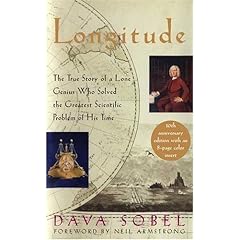
Longitude

I just finished reading Longitude, by David Sobel. This is the story of the man who invented the first clocks capable of telling accurate time whilst enduring the rough conditions of the open seas. This being vital for establishing ones longitude when navigating. Before this was possible many ships and lives were lost due to not knowing the accurate position of the ship.

The story follows John Harrison, a self educated passionate clock maker from England, who built his clocks at a time it was considered impossible.

Along the way there's lots of interesting history, and some familiar figures from history show up including Isaac Newton, Robert Hooke, King George III and Captain Cooke.