Showing posts with label studio ghibli. Show all posts

Tuesday, August 26, 2014

The Wind Rises (2013)

Whilst on vacation I spent some time in the evenings watching Studio Ghibli's "The Wind Rises". This is a fictional biography of Jiro Horikoshi, creator of the "Zero" fighter which Japan used during WWII.


The story follows Jiro from his childhood, where his dreams of being a pilot are dashed by poor eyesight. After reading an aviation magazine he dreams of meeting a famous Italian aircraft design, Caprioni. In later dreams Caprioni tells him that building planes is better than flying them.

After an earthquake meets a girl called Nahoko and helps her and her maid to safety. Later on they meet again and a relationship blossoms.


Between his relationship with Nahoko, the work designing planes and the tense political atmosphere of wartime Japan, a lot happens to Jiro. That said, the story moves slowly, and I found my attention drifting away, hence watching this over a few evenings instead of all at once. 


The animation and artwork are amongst the best of the Ghibli movies, most notably the dream sequences with Caprioni and a scene where Jiro and Nahoko play with a paper plane. 


I really enjoyed the sound effects made by the planes as their propellors hum. They have an almost human quality to them.


The Wind Rises caused some controversy in South Korea and China, as it could be considered to be glorifying war and Japan's military. I didn't get that impression. The story is really about Jiro's dedication to building a beautiful airplane, whilst balancing taking care of Nahoko and his own ethical concerns about making a killing machine.


The Wind Rises is certainly watchable and enjoyable, though not as fast paced and action packed as many of the other films and, happily, not as sad as the other film Grave of the Fireflies.


Check out my other Studio Ghibli reviews:

http://justinhj.blogspot.ca/search?q=ghibli


Sunday, February 19, 2012

The Secret World of Arrietty


This is the 9th review I'll have written about a Studio Ghibli movie, but the first that I have seen in the theatre. We went along for to see the North American release of the 2009 movie, which has been dubbed in French and (British) English already. As a kid I really enjoyed the Borrowers books by Mary Norton, but I can't say any of the movies and tv shows based on the works impressed me much. So it was pleased to hear that Studio Ghibli were making the movie, and in fact the founders of the studio have been thinking about doing so for 40 years!

Borrowers, if you do not know, are 10cm tall people that live hidden in our houses, and get along by 'borrowing' things that we won't miss. Borrowers must never be seen, as once curious humans are dangerous, so once spotted they must uproot and move to a new home immediately. This movie takes the Borrowers story and relocates it in Japan, telling it the style of the many Ghibli movies before it.


The story begins when a young boy, Shō, is driven to the house in Tokyo his mother grew up in, to stay with his Great Aunt. While his Aunt goes into the house alone, he investigates the garden where a large (fat) cat is investigating a bush. The cat takes off and Shō catches a glimpse of our hero Arrietty as she slides down the stem of a flower and out of sight. Later that night we join Arrietty in the Borrowers home, as she prepares with her Father for her first dangerous journey up into the house to acquire sugar and tissue paper.


As with all Ghibli movies, the heroes are the children. The adults may be busy, sick, turned into pigs or just not give a damn, whilst the kids are independent, fearless and trying to grow up. In this movie the father is a strong yet silent type who obviously runs a tight ship with his family but is not afraid to let Arrietty grow up and take on dangerous work. The mother is more of a worrier, very comfortable in her little Borrower home and not wanting anything to change that. Of course Arrietty soon gets into adventure, or misadventure, with her parents nowhere to be seen.


Having seen a lot of animated movies aimed at kids recently, it was refreshing to watch one where the pace of the story was slow and thoughtful. Rather than being 90 minutes of action and drama, there is time for tension to build as the characters face increasing danger. There is time to watch amazingly animated beetles, centipedes and ants interact playfully with Arrietty, and for the sour faced fat house cat to play with Shō as he lies on the grass.That said there is plenty of action too, and the movie is never dull. It should appeal to most age groups.

The audio is notable, in that the sounds of everyday objects have been amplified and deepened in pitch so they become alien and scary when heard as if through the ears of the tiny people. I thought the soundtrack sounded like it was influenced by Irish or Spanish folk music, and really suits movie, but in fact was created by French musician Cécile Corbel. From Wikipedia:

"Corbel also performed the film's theme song, "Arrietty's Song", in Japanese, English, French, German and Italian. Corbel became known to Ghibli filmmakers when she sent them a fan letter showing her appreciation of their films, together with a copy of her own album."

There's no need for me to say that the animation and backgrounds are gorgeous, but it's certainly amongst the top three Ghibli movies. In particular the animation of the creatures in the movies is both lifelike and at the same time they have a lot of personality. The Borrowers house is as richly detailed as the real house upstairs.


Much as I love all the Ghibli movies, this is now among my favourites. Arrietty is a strong, attractive and likable character, whilst Shō is a tender and pleasant one. The movie explores some serious themes without getting too morose or serious, and gets nostalgic without being sentimental.

Monday, February 6, 2012

Ocean Waves

A while ago I set myself a goal to watch and review all of the Studio Ghibli movies, since I enjoy them a lot, and I wanted a way to remember what each one was about. (I am losing my marbles you see.) Here's my eighth one.


Ocean Waves was made for Japanese television, directed by Anime producer Tomomi Mochizuki, his only Ghibli title. Despite being made for TV it ran over budget and over time (when does anything good not?).

Set in a rural city of Kōchi on the Japanese island Shikoku, it's a high school "love story" of sorts. The main characters are friends Taku Morisaki and Yutaka Matsuno. Strong willed they make a stand alone against the school authorities when a school trip is cancelled due to poor academic performance. (The kids instead get to go to Hawaii, my heart bleeds!) Japanese school children being much more deferential to authority and elders, their behaviour is quite something to the other kids. Taku in particular seems an independent and strong willed fellow.


Meanwhile, following a marital break up Rikako Muto must attend the high school in Kochi having previously lived in Tokyo. She quickly moves up the schools academic league table, and feeling more sophisticated than the other students in Kochi she doesn't make friends. Instead she is defiant and doesn't take part in school activities.


Needless to say the boys are attracted to Rikako. Yutaka expresses this openly to his friend Taku. As the story unfolds Taku connects with Rikako. Initially they mock each other, but Taku helps Rikako and she quickly decides that she can both trust him and exploit him to enact her plan to visit her father in Tokyo.


Taku has to do all the work in this story, both to maintain his friendship with Yutaka and Rikako, but he never seems to be bummed by it, and his personality is refreshingly strong and positive.


This movie won't appeal to kids as the story line is too mature to be interesting (not that there is anything inappropriate though). I really enjoyed it however, it's typical Ghibli. Beautifully drawn and animated in the usual style. The characters and the world itself feel fully real.
Wednesday, March 30, 2011

Princess Mononoke

I'm trying to watch and review all of the Studio Ghibli movies... here's my 7th one:


Princess Mononoke (1997) is written and directed by Hayao Miyazaki. It has a similar theme to a lot of other Studio Ghibli movies (Castle in the Sky and Naussica as examples), the battles between humans and nature. The story follows the adventures of Ashitaka, who is a brave young warrior who battles a giant cursed Boar in the opening scenes of the movie. Mononoke means monster or spirit.


(This is the Japanese movie poster. I think you can see why they changed it for the US audience. A girl with a bloody mouth and a knife would not sit well on the walls of the local theatre)

The village elders convene and determine that he must journey to the West in order to find out what is happening there to drive evil their way, and possibly find a cure to his curse, which otherwise will kill him.


Arriving in the fortified mining colony of Tatara, he quickly wins the trust of the people there with his fighting skills. The town is battling the creatures of the forest, and San (a girl raised by a giant White wolf god) who are trying to stop the humans from chopping down all the trees to mine iron ore. Lady Eboshi (voiced beautifully by Minnie Driver in the English version), is leading the fight against the forest with her army and with guns. It turns out a pellet from one of these guns is what turned the giant Boar evil in the beginning.


Ashitaka meets and gains the trust of San which leads to animosity when he returns the town. There is conflict between the creatures live in the forest and don't want the trees to be chopped down and the humans want to destroy the forest in order to mine and build their town into a powerful and rich city. Even the humans are conflicted and complex characters.

Much of the movie is action packed battle with packs of giant creatures swarming through the forest. Ashitaka rides an Elk which is beautifully drawn and animated. The giant Wolf gods, Boars and the spirit of the forest are all believable yet extraordinary.


This is a new favourite of mine, a deep and sophisticated story, but quite light and filled with humour. I'm surprised I didn't come across it earlier, because according to the wikipedia page it was a huge hit in Japan; the highest grossing movie until Titanic in fact.

Sunday, February 6, 2011

Only Yesterday

This is my sixth review of Studio Ghibli movies. I watched "Only Yesterday", which is by the same director as Grave of the Fireflies (Isao Takahata). Disney own the US rights to this movie, and have not distributed it yet [ahem]. The main character, Taeko, appears in the story both as her grown up (27) self, and as a 5th grade schoolgirl.


This is a movie that accurately captures feelings of unachieved dreams, of living a life that your 5th grade self would not feel comfortable with. Bored with her city life in Tokyo, Taeko takes a trip to the country (Yamagata) to visit her sister inlaw. She meets Toshio, and works with him in the countryside where he is a farmer. Toshio is passionate about nature, organic farming, and this captivates Taeko.


The film keeps switching back and forth between our present day Taeko, and her 5th grade self. Her schooldays reflect the day to day ordeal of school social life, and her alienation from her parents. Her two sisters simply study and do well at school. But Taeko seeks a deeper understanding of the material, and finds it more difficult to learn what she needs to by passive acceptance and rote. This is interesting as I was exactly the same at school. She instead prefers to put effort into her own interests, and in going the extra mile in her minor part in a school play she is noticed by a town theatre company and asked to star in thir own production. Sadly her father does not see this as something good for her and prevents her from attending. Her relationship with her father is particularly difficult, as he is a stern and rough man.


The animation is realistic, especially in the facial expressions, although the 5th grade scenes are drawn in a simpler style, perhaps to contrast the simplicity of childhood against modern life. Only Yesterday portrays nicely not just falling in love with another person, but falling in love with another life, as one often does on vacation or when visiting another place. At times Taeko's 5th grade self is right there with adult Taeko in the same scenes, and perhaps this is the theme of the movie: your childhood self is always with you, and always you can judge yourself from those early innocent days, when the realities of adult life were not upon you, and the sky was the limit.

Saturday, August 7, 2010

Laputa: Castle in the Sky

In this, my fifth Studio Ghibli movie review, I look at the 1986 work Laputa: Castle in the Sky. Based in a world where people once lived in the sky, some disaster had brought everybody down to earth again. The Castle in the Sky is the last city still airborne, lost to the modern world and hidden amongst storm clouds.


As with virtually all the movies from SG, the story is told from the point of view of children. Sheeta, a girl who seems to have some connection with Laputa, and a magical pendant, teams up with Pazu (who's adventurer father had taken a picture of the Castle in the Sky).

Sheeta and Pazu are pursued by sinister government agents and a gang of pirates lead by an old woman called Dola (who looks very like Yubaba, the witch from Spirited Away).


The movie was somewhat disappointing as it is an epic tale, but compared with more recent SG movies it looks rather dull. Although it has plenty of action and some hilarious slap stick comedy moments, it doesn't have a lot of character and life, and I didn't feel that emotionally involved with the characters.


The sound track is lively and simplistic 80's music, which sounds somewhat retro now (in a good way).

Laputa's story has a slightly environmentally friendly feel to it which I liked, at one point Sheeta recites:

Put down roots in the Earth;
Let's live with the wind;
With seeds, make fat the winter;
With the birds, let's sing of spring.

Monday, July 26, 2010

Grave of the Fireflies


Fourth in my reviews of Studio Ghibli movies, is Grave of the Fireflies. Made in 1988 this is the only Studio Ghibli movie which Walt Disney does not have the US distribution rights for, as it was made with Shinchosha, the company which published the book by the same name. (All the movies are funded by a parent company called Tokuma Shoten).


That the story is semi-autobiographical makes it all the more heart breaking, yet that is also probably the reason the movie is so human, and so authentic.


The city of Kobe in Japan was fire bombed on March 17th, 1945. Over 300 US bombers took part in the attack which targeted the wooden homes of civilians, and in the resulting fire storms over 8000 people lost their lives. This tale begins at the end, in Tarantino style, with the death of a pre-teen boy, Seita, and his younger sister Setsuko. He dies of exhaustion and starvation in a busy train station, where his dead body is treated as an annoyance by callous cleaners. His spirit rises from the body and he walks out to meet his little sister who is waiting for him. They are lit by the rosy glow of fireflies fluttering in the night.


Then we return the real beginning, as sirens wail and they make preparations to head for the bomb shelters before the bombers arrive. Their mother rushes off, leaving Seita and Setsuko and telling them to meet her their quickly. Caught in the fire bombing, yet escaping injury they flee to a river bank where they wait in relative safety.

Injured in the firestorm, their mother can no longer take care of them, their father is in the Navy at war, and Seita and his younger sister go to live with their extended family. The woman treats them cruelly and eventually they decide to leave, and find an abandonded bomb shelter by a lake. Things get much worse as their rice supplies dwindle and Seita turns to more extreme measures to support them.

Things continue much like that, and it sounds like a very grim tale, and not at all entertaining. But as with movies like Schindlers List, what makes the story worth telling is not the terror and the stalk reality of adult war meeting the innocent world of child, but the humanity and hope, that can prevail, even if only ephemerally.

Seita is the perfect big brother, doing everything he possibly can to mitigate their terrible circumstances; even braving air raids to steal from empty homes. Setsuko is a bubbly and happy girl, always playing and shouting for her sibling with a cute little voice. Firelies being a theme of the movie, she collects together a handful that have died, their fire extinguished, and makes them a little grave by their lake.


What stands out in the movie is the active cruelty towards the children, or at best callous disregard for their plight, and in contrast is the hope and dogged determination that Seita instills.

Although it's a very grim story, it is never overtly graphic or horrific. Probably not recommended for young children, but I wouldn't be over-squeemish about showing this to older children.


As you can see in these screen shots, the orange glow of fireflies is used to great effect to emphasize the warmth of the relationship between Seita and his little sister. A cute little box of candy lasts the duration of the movie, and mirrors the gradual decay and eventual resurrection in the after life of the two children.


Finally an amusing fact; this grim anti-war movie was released as a double-feature in Japan with the much more light hearted My Neighbour Totoro! Quite a contrast. Although not a great success financially at the box office in Japan, the sale of Totoro toys (Cat Bus and Totoru) soon made up for that, and firmly established Studio Ghibli for it's future movies.

Saturday, July 10, 2010

Nausicaa of the Valley of the Wind


Nausicaa of the Valley of the Wind was made before Studio Ghibli existed but is often included in their list of works, and is really the beginning of the studio. I watched a pretty decent dubbed version with voices from the likes of Alison Lohman and Uma Thurman. Alison's voice is really perfect for the main characters voice; the princess of the valley known as Nausicaa.


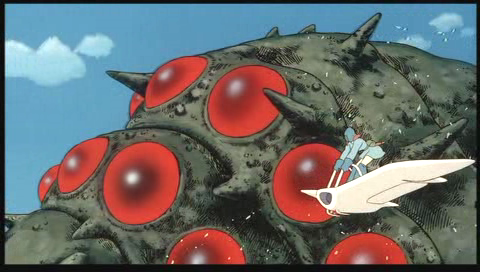
The movie was made in 1984, and the music is very 80's; sounding somewhere between a sleazy porn movie and an 8-bit video game. The movie looks very surreal, being set in a post-apocalyptic world where most of the planet is covered by a toxic jungle. Humans cannot enter the jungle without masks to prevent them being poisoned by spores. It is filled with dangerous creatures, including giant Ohm's, which are huge caterpillar like things, covered in eyes which glow red with fury when they are provoked.


Nausicaa is a princess loved by her people; who is able to communicate with and calm the creatures of the jungle, as well as people. She's a genuine hero, she flies a jet glider skillfully, she always does the right thing, she's an environmentalist and animal lover. Needless to say when her world is threatened, we feel bad for her and want to save it.


It's definitely one of the best SG movies so far, and my son who is 8 loved it too; one that we will watch again and again.


Sunday, June 27, 2010

Whisper of the Heart

I'm on a mission to watch and review all 19 movies from Studio Ghibli. This weekend I watched 'Whisper of the Heart', their 10th movie.


This is probably the SG movie with the least actual magic in it; the animals don't talk (but they do ride trains!). But it is a really nice coming of age or first love story about a school girl called Shizuki. The theme song of the movie is John Denver's "Country Roads", which Shizuki translates into Japanese for a school project, and also writes her own lyrics for based on her own life in a Tokyo suburb.

A sad fact about the movie I found on the wikipedia page, linked below, is that the director of this movie died just a few years later from an aneurism. He was expected to be a successor to the directors Miyazaki and Takahata.


Like most of the other movies the children are the main characters of the story, and are left to roam the streets of a Tokyo suburb late at night. The parents expect the kids to take care of themselves and also make the dinner and do a lot of house work; I hope my son takes notes on how lucky he is!

One thing that struck me about this movie is how beautiful and detailed the interiors are; for example this scene in Shizuki's kitchen.


The city scenes are also incredibly rich, with subtle details bringing everything to life. The animation of cars, trains and especially the bike riding of Shizuki's friend Seiji is extremely convincing.

Whilst there is no actual magic in this movie, there are some really beautiful moments. It's not just a story of high school sweet hearts; it's about ambition, artistic endeavour and whether to risk it all for your dreams or take the safer path.